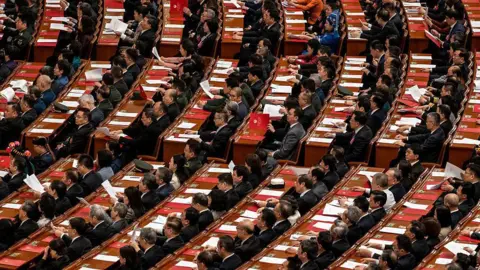
China’s biggest political gathering – the National People’s Congress or NPC – has come to an end.
Its extensive authority includes making laws, amending the constitution and approving state budgets. But it effectively functions as a rubber-stamp parliament, approving decisions made behind closed doors by the top echelons of the Chinese Communist Party.
Still, the annual meetings of the NPC and the Chinese People’s Political Consultative Conference (CPPCC) – also known as the “two sessions” – are watched closely as they signal the priorities of the world’s second-largest economy.
Our correspondents give us their biggest takeaways.
China wants to show it is a beacon of stability
By Laura Bicker, China correspondent
China’s push to be the world’s leading superpower depends largely on one key thing – President Xi Jinping’s ability to manage his economy.
To achieve this, Xi appears to be seeking more certainty as he tries to balance the books in a very uncertain world dominated by an unpredictable US president and a war in the Middle East.
His policies to try to encourage Chinese people to spend more money are aimed at stabilizing a stuttering domestic economy.
His push for technological supremacy is a bid to win the future and get others to come to China’s door for the latest factory robots or AI models.
His continuing push toward increasing China’s production of renewable energy will allow the country to be more self-reliant. It no longer needs as much oil and gas from other countries including Iran.
And then of course there is the choreography of such a major political event, from the practiced pitch of the band, to the diligence of delegates who sit and listen to speeches and even turn pages in perfect unison.
The quiet, heavily controlled and carefully scripted statecraft in the Great Hall of the People stands in contrast to a fiery White House which has rattled allies and shaken markets with its strikes on Iran.
The Chinese Communist Party is trying to show that it is a beacon of stability that is in the business of fixing its economy and future.
Xi will feel China is already in a strong position after fighting back against US tariffs in a trade war that ultimately ended in a truce. China’s trade dominance is also attracting back former wary customers including the UK and Canada.
The geopolitical landscape is shifting, and Xi may see an opportunity for China to rise, as his rival in Washington is distracted.
But he will also know much depends on how his country navigates its own economic challenges in the years to come.